



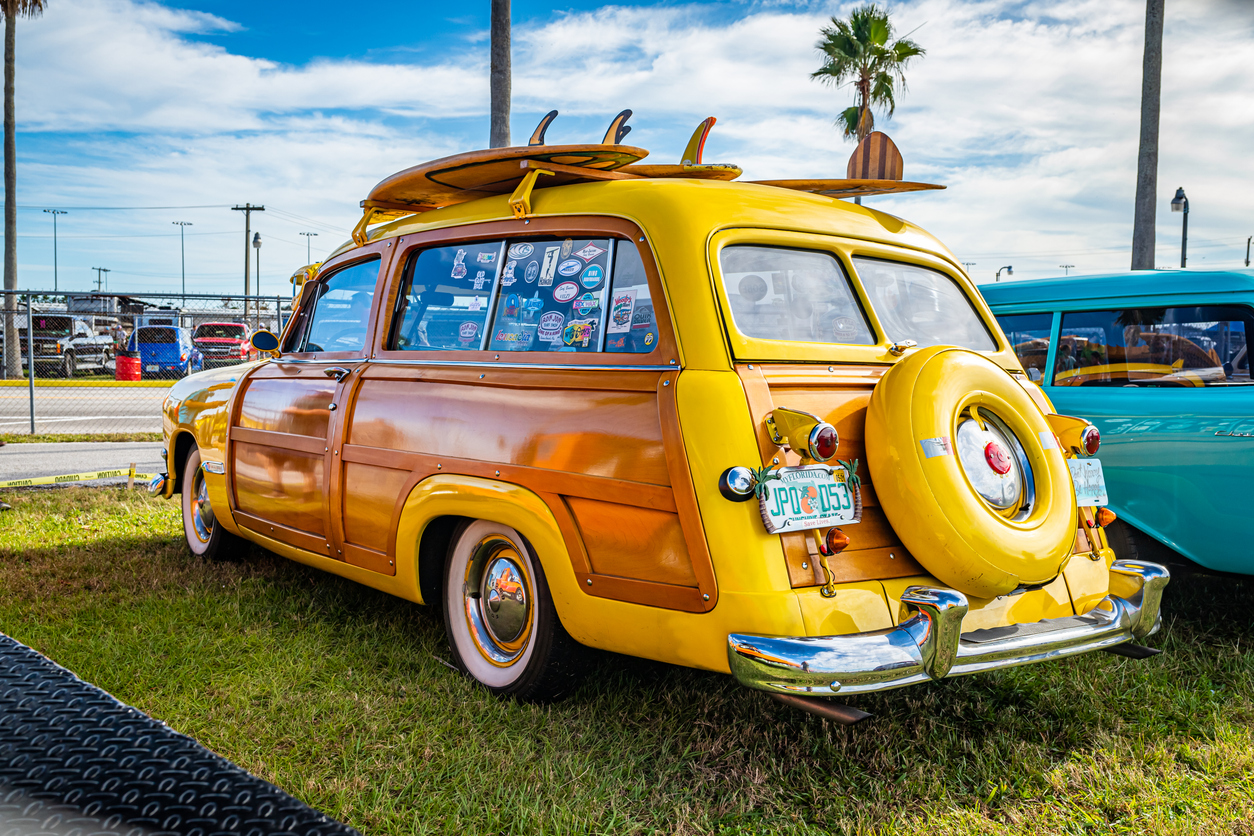
The month of July has us feeling a little extra patriotic since Independence Day, so we thought it would be fun to take a little deep dive into the history of one of America’s most classic car designs: “The Woody Wagon”! On today’s blog, we’re going to take a look at this unique car design and its evolution from the earliest cars in the 1900s. So fasten your seatbelts, friends, we’re driving 88mph into the past for a unique history lesson on vehicle design.

A History of Early Automobile Framework and Manufacturing
Today’s vehicles are crafted from sturdy metals like fiberglass, steel, and aluminum, as well as more sustainable materials such as recycled metal, recycled plastic, synthetic composite materials, and even recycled fabric fibers, but did you know that some of the earliest cars were actually designed with wooden frames?
In the late 1800s and early 1900s, some of the first car designs were actually hand-crafted from wood by highly specialized skilled body builders. Even as the vehicle designs began to evolve and change, in many cases steel was installed over the top of a wooden framework which was carefully bent, fitted, and molded by hand with special tools.
In the 1920s and 1930s, car bodies began to shift to wood and steel construction, and later to an all-steel framework. As automakers began to produce more vehicles and created an assembly line to aid the process. were created from stamped steel pieces and welded together, eliminating the need for highly specialized skilled labor.
In modern day times, the process of vehicle manufacturing began to utilize more automated machinery, and now it is almost entirely automated with machinery and robots.
Even though these modern advancements have increased the safety, durability, efficiency, and accessibility of cars, car enthusiasts still long for the beauty and aesthetics of those earlier days.
A Brief History of Wooden-Bodied Cars and Creative Car Designs
As previously mentioned, wood was a core part of the original vehicle design, but the classic “woodie car” look and energy that collectors love is most usually referring to the vehicles of the 30s, 40s, and 50s. These uniquely styled cars featured custom wooden bodies and panels fitted onto a steel frame and chassis.
A “woodie” refers to a wood-bodied automobile that’s either constructed of wood or features wood-look elements in the design. Wood was chosen to add luxurious depth, style, and class to create a unique timeless daily driver. In many vehicles, the exterior wood panel look was also continued on the interior in the form of dashboard panels, door panels, center console frames, and other detail work. The original body-on-frame construction was seen on station wagons, utility vehicles, and later sedans and convertibles.
Early woodie models include the 1910s Rolls-Royce Silver Ghost, 1920s Ford Model T, the 1930s Ford Prefect and Ford Deluxe Station Wagon; the 1950s Nash Ambassador Suburban, 1940s Chrysler Town and Country, 1940s/1950s Packard Station Sedan, and the 1950s-1970s BMC Morris Minor Traveler just to name a few popular entries.
As vehicle design trended towards automation and more accessible materials such as metal, automakers began to evolve from utilizing actual wood materials to sheet-vinyl appliques and plastics to evoke the wood grain look with more modern materials. Vehicles that employed this technique include the 1960s Chevrolet Caprice, 1970s Chevrolet Vega,1970s Pontiac Grand Safari, the 1980s Mercury Colony Park, 1980s Plymouth Voyager, the 1990s Jeep Grand Wagoneer, and the 1990s Buick Roadmaster Estate Wagon.
Vintage Woodies and the Collectors Market Today
It’s nearly a century later, and these charming and quirky vehicles are still one of the most desired styles of car to collect. These vintage vehicles are beloved amongst car enthusiasts due to the fact they represent the rise of the quintessential American Suburban Culture. These ever-popular vehicles made family vehicles look a little more stylized and evoke feelings of nostalgia for yesteryear. Today, woodies are often a featured car category at car meets, classic car museums, and in personal collections. Models that feature real wood in the design are a cut above the rest, and are highly sought after. Restoring these cars is a labor of love, allowing us to step back in time for just a moment to the golden years of automobiles and truly appreciate fine craftsmanship.
Want to learn more about Woodie Vehicles? Check out this fun video from Ed’s Auto Reviews that takes an even deeper look at the history, design, and purpose of these amazing vehicles.
![[Facebook]](https://www.classicdirecttoyota.com/blogs/293/wp-content/plugins/bookmarkify/facebook.png)
![[LinkedIn]](https://www.classicdirecttoyota.com/blogs/293/wp-content/plugins/bookmarkify/linkedin.png)
![[Twitter]](https://www.classicdirecttoyota.com/blogs/293/wp-content/plugins/bookmarkify/twitter.png)
![[Yahoo!]](https://www.classicdirecttoyota.com/blogs/293/wp-content/plugins/bookmarkify/yahoo.png)
![[Email]](https://www.classicdirecttoyota.com/blogs/293/wp-content/plugins/bookmarkify/email.png)
Connect with us


- 2026 Toyota Tacoma Towing Guide: Real-World Performance in Waukegan, IL
- The Race for Best Compact SUV: 2026 Toyota RAV4 vs Honda CR-V in Northern Illinois
- The Icon Reimagined: 2026 Toyota 4Runner vs. 2026 Toyota 4Runner i-FORCE MAX in Waukegan
- Beyond Zero: Your Guide to the 2026 Toyota Electrified Lineup at Classic Toyota
- More Than a Commute: The Top 5 Features of the 2026 Toyota Corolla