



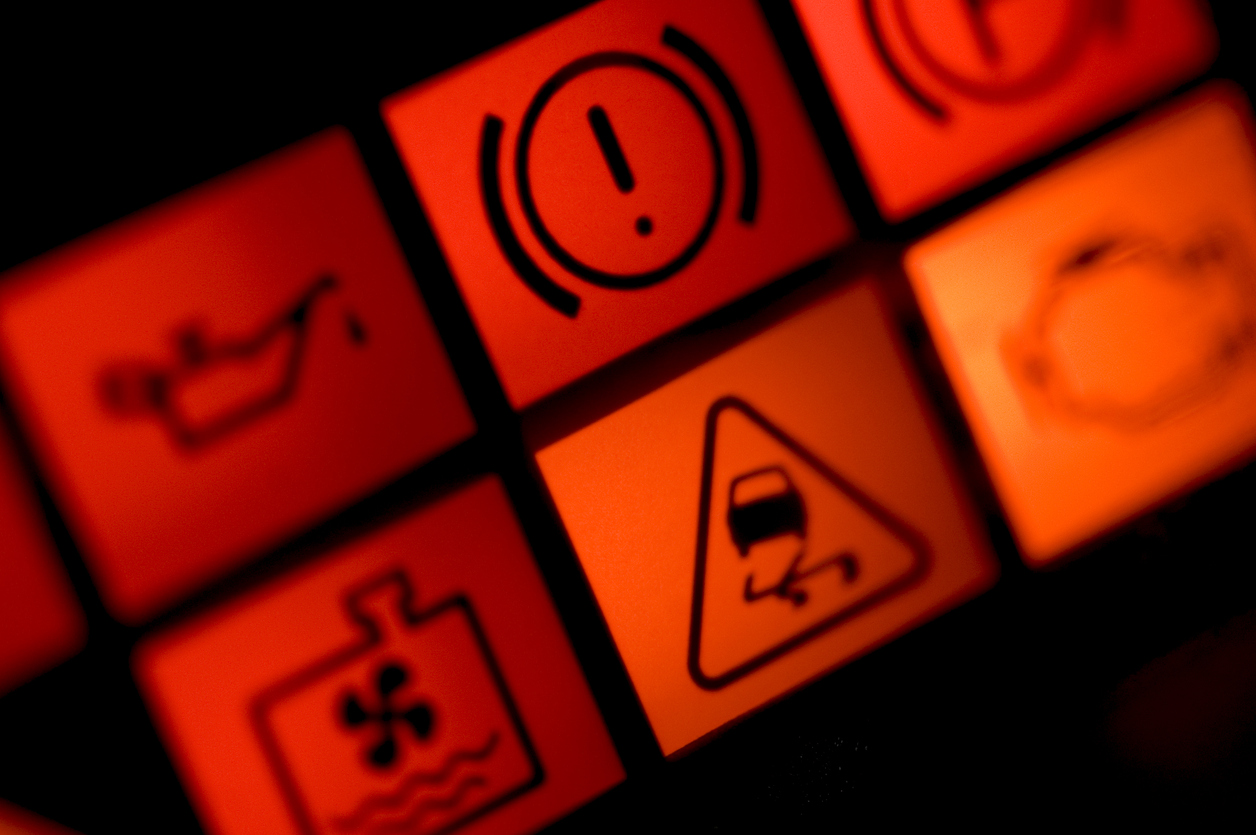
Today we’re sharing our helpful Gearhead Guru Guide’s Decoder to A Vehicle Dashboard’s Lights, just in time for road trip season to kick into full gear. Dashboard warning lights are your car’s way of communicating with you that something is out of whack. These issues could be something as simple as an electrical malfunction to something more seriously wrong like an engine seizing. Understanding the basic dashboard lights is crucial for any car owner, but especially for the budding home mechanic. Remember, any time you’re about to embark on a long road trip, you should bring your car in for an evaluation and inspection; let your mechanic know how many miles it will be driving and where, so they can evaluate its readiness and reliability.
Please note that dashboard lights may vary slightly from model to model, or even from year to year. The symbols below will help guide you through and avoid guesswork, and are standard on most vehicles. For the most accurate depiction of your make/model’s lights, you can check your vehicle’s instruction manual from the manufacturer.

The Engine Temperature Warning Light
On your vehicle this may look like a thermometer with wavy lines below it or simply the word TEMP in all caps. Either way, this is one of the major lights you do not want to ignore. This is a sign that your engine is experiencing a serious problem and is overheating. The best thing to do is pull over as soon as you can, and turn off the engine. You will want to pull over and request emergency roadside assistance and have it towed to the nearest or local service center. Sometimes an engine overheat issue can be a radiator issue, the cooling fans, faulty water pump, a blown head gasket, or malfunctioning thermostat.
Parking your car in the shade can help your engine stay cooler in hot summer weather. To maintain your engine at optimal health, you’ll want to change the coolant every 30,000 to 100,000 miles depending on your vehicle’s make/model, age, and the type of coolant used. The coolant temperature sensor generally lasts around 100,000 miles, but does occasionally fail before then if the coolant system is improperly maintained.

The Oil Pressure/Oil Level Light
This will look like a little can of oil with a droplet or simply the word OIL in all caps. When this light is on, it means that your vehicle’s oil is dangerously low. This could signify that you’ve forgotten an oil change or top off, or it may indicate a serious leak in oil. You may notice blue smoke coming out of the exhaust, which is a sign the engine is burning oil. Your vehicle could be damaged significantly if you continue to drive it in this condition. Your best option is to pull over and check the engine oil levels. You’ll want to call roadside assistance and have it towed to the nearest or local service center.
The most common cause of low oil pressure is the oil level dropping below the minimum. To fix low oil pressure, you’ll want to check your engine oil level and then top off the oil. In a more rare occurrence, this may indicate a faulty oil pressure gauge.

The Check Engine Light
This is the most notorious light on your dashboard, and chances are you’ve experienced it at least once if not more in your lifetime if you’ve driven an older vehicle or have not maintained your regular tune-ups and service calls. This symbol looks like a miniature car engine, or may just be the word ENGINE in all caps. This indicates that your vehicle’s on board computer system has received an error code, also known as a Diagnostic Trouble code or DTC. Your local mechanic will be able to read the code using a special piece of equipment to find out what triggered the light. They’re not always emergency alerts, but it’s best that you do bring your vehicle ASAP to ensure that it is not a catastrophic issue; the sooner you bring it in, the less likely you are to continue to do more costly damage to your vehicle.
To avoid experiencing a check engine light, properly maintain your exhaust system; check that the gas-cap is properly seated; bring your vehicle in for regularly scheduled oil changes, coolant flushes, service tune-ups; don’t delay otherashboard light check-ups. Additionally, you can purchase your own OBD-II Scanner which can read the fault codes triggering the check engine light, and better help you diagnose the issue; some issues may be repairable by the average home-mechanic or car enthusiast for pennies on the dollar!

Brake System Warning Lights
Usually this dash light indicates that you’ve accidentally left your parking brake engaged. However, if the light is still illuminated when the parking brake has been disengaged, you’ll want to bring the car in for an inspection at your local mechanic. This may indicate a serious problem in your vehicle’s brakes system, and that is a vital repair as it’s dangerous to drive with faulty or damaged brakes and reduces your ability to avoid accidents. It may indicate that you are experiencing hydraulic loss, low brake fluid in the master cylinder, an issue with the ABS, new brake pads, or parking brake adjustment among other things.
To head off the brake warning lights, ensure that you’re maintaining the brakes system with annual check-ups. It’s also important to inspect the brakes as part of each oil change interval. Your brake pads should be replaced if you hear any squealing noises, and ideally if they’ve reached their minimum safe thickness of 3-4mm, or at 25,000-50,000 mile intervals.

This battery warning light is very easily decoded, as it looks exactly like the item it monitors. It may indicate an issue with the battery itself, issues with the alternator, faulty electrical wiring, or some other related electrical component. If this light is also accompanied by start up issues, this may indicate you need a replacement battery or a jumpstart.
Make sure to regularly inspect the car battery’s electrical contacts and keep them clear of corrosion. Avoid running the electronic systems like the lights, radio, infotainment, or GPS without the engine actively running to avoid draining the battery. Always make sure to carry a set of jumper cables, and ideally a portable car battery charger just in case of emergencies. On average, these batteries last 3 to 5 years.

This light indicates that you’re driving on tires that are over- or under-inflated, as indicated by the wheel shaped symbol with a flat bottom and bulging sides. As the weather changes and temperatures fluctuate, this can affect the pressure in your tires. If you see this light, take a second to check the pressure and either add air or let some out. If that doesn’t solve the problem, it may indicate that there is a leak or damage to one or more of the tires, and you’ll need to bring it in for a service checkup.
![[Facebook]](https://www.classicdirecttoyota.com/blogs/293/wp-content/plugins/bookmarkify/facebook.png)
![[LinkedIn]](https://www.classicdirecttoyota.com/blogs/293/wp-content/plugins/bookmarkify/linkedin.png)
![[Twitter]](https://www.classicdirecttoyota.com/blogs/293/wp-content/plugins/bookmarkify/twitter.png)
![[Yahoo!]](https://www.classicdirecttoyota.com/blogs/293/wp-content/plugins/bookmarkify/yahoo.png)
![[Email]](https://www.classicdirecttoyota.com/blogs/293/wp-content/plugins/bookmarkify/email.png)
Connect with us


- 2026 Toyota Corolla Buying Guide
- 2026 Toyota Camry Showroom Walkaround
- 2026 Toyota Tacoma Towing Guide: Real-World Performance in Waukegan, IL
- The Race for Best Compact SUV: 2026 Toyota RAV4 vs Honda CR-V in Northern Illinois
- The Icon Reimagined: 2026 Toyota 4Runner vs. 2026 Toyota 4Runner i-FORCE MAX in Waukegan