



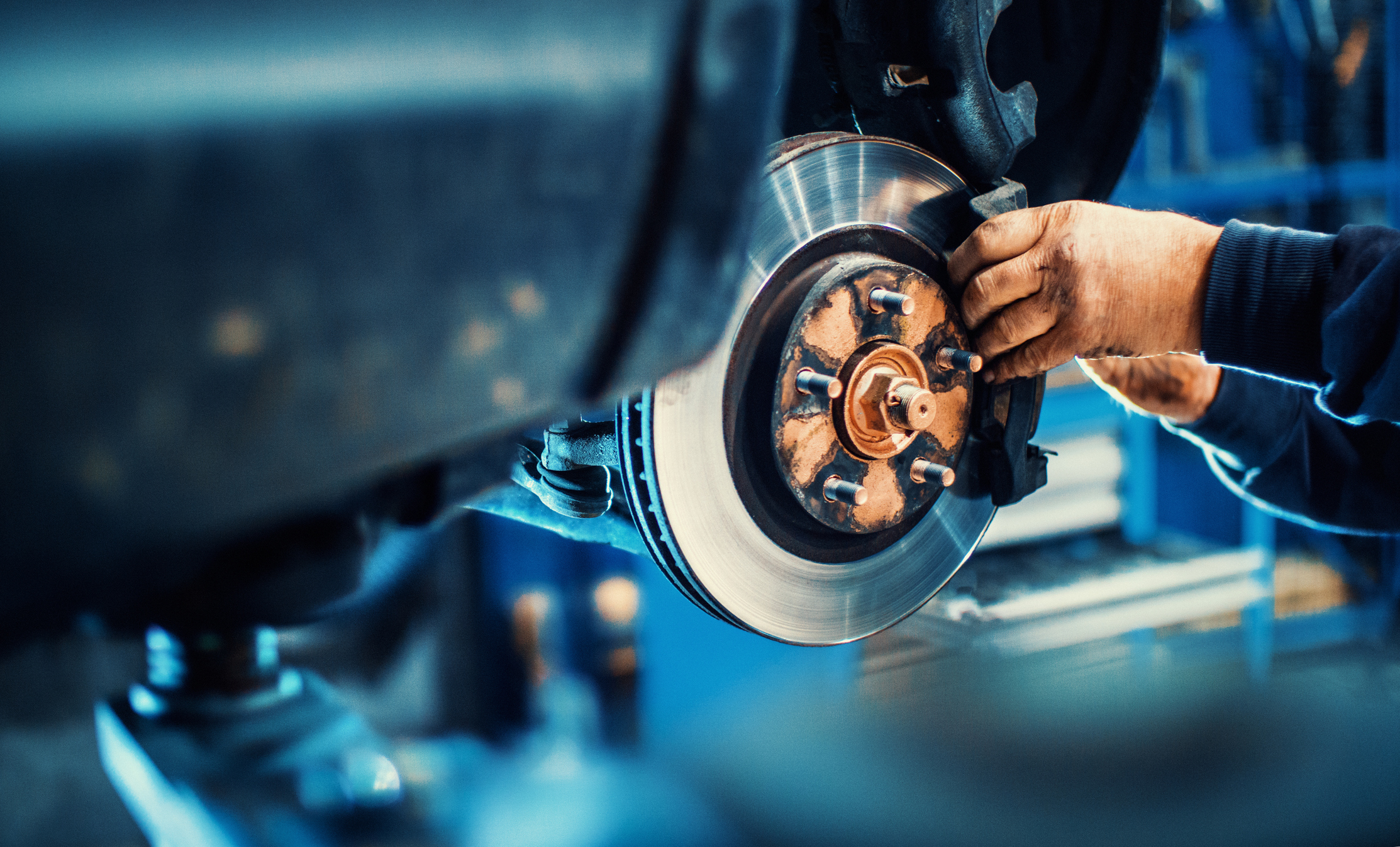
Today we’re chatting a little bit about some winter weather car care tips. One of the most important parts of your vehicle is the brakes!
It’s imperative during inclement weather that you’re able to stop on a dime, and in conjunction with all-season or winter tires, you’ll need to make sure your vehicle has a tip-top shape brake system. We’ll be “braking” it down (see what we did there?) into easy to digest sections such as different terms for parts in the vehicle’s brakes, as well as signs to look out for that the brakes need a checkup. On most vehicles, you’ll need a regular brake service between 25,000 to 65,000 during which your mechanic will replace the brake pads; rotors will need replacing 30,000 to 70,000 miles. These numbers may vary depending on driving style, road and terrain conditions, and weather.

Let’s take a look (and a listen) at some of the signs that you need a repair on your brakes!
First, you should do a very thorough visual inspection of the brakes. Check between the spokes of the wheel for the rotors, they should be free and clear of rust or extreme wear such as deep scoring or grooves. If the brake pads appear to have any buildup, or they look visibly thin, around less than ¼” thickness, they will need replacing asap. Most modern vehicles also have an indicator mark in the center of the brake pad. On some newer vehicles, you may also see a brake warning indicator light; note that this is the same light that is engaged when your e-brake or parking brake is in use, so if you see this illuminated and that is not engaged, call your trusty local service center.
As for audible signs that things are getting a little rough, you may notice squeaking or squealing noises. This indicates that your brakes are at the very end of their life, as the squealing is caused by excessively worn brake pads. (Sometimes loud screeching noises may indicate that your rotors need replacing due to excessive braking, which you can spot by checking for the appearance of a dark ring on your rotors.) If you hear a grinding sound when applying pressure to the brakes, they’ll need a service ASAP! This grinding sound is generally due to a metal indicator that’s engineered to make a very loud sound to alert you that the brakes are on their last legs.

While driving, you may also begin to notice some physical sensations on the road that indicate it’s time for a brake check. Properly working brakes should allow the vehicle to roll smoothly to a stop. Any sort of vibrations while stopping, shaking of the vehicle, or vibrations in the steering wheel can all indicate the brake pads and rotors are worn or damaged. If you are stepping on the brakes and notice that you have to push the pedal all the way to the floor to engage the brakes, this may be an issue with the hydraulics. Likewise you may notice the opposite, as the vehicle is stopping a little too short or jerking forward as you stop, which indicates that the brake fluid needs replenishing or the rotors need replacing due to uneven wear.
If you notice a puddle in your driveway under the car that has a yellow or brownish tint to it, sort of like a thin motor oil consistency, that indicates a leak in your brake fluid. This may be followed by a spongey or soft feeling when depressing the brake pedal. The car may also occasionally pull to one side when pressing the brakes. Additionally a spongy or soft brake pedal may indicate an issue with the master cylinder, which also may be followed by the brakes pushing to the floor but not returning back up.

Parts of Your Vehicle’s Braking System
When you’re bringing your vehicle in for service, you may hear some of these terms used by your mechanic and technicians. We hope that this will better equip you to be able to navigate the conversation and better comprehend the process of the repairs.
Brake booster
A vacuum-based device that amplifies the foot pressure applied to power brakes.
Brake booster bellcrank pivot
The linkage pivot points behind some brake boosters.
Brake drying
A system that dries the brake pads through light friction just before a full stop is initiated, by using the ABS pump to bring the brake pads close to the rotors without significantly engaging them.
Brake fluid
The fluid used in the hydraulic brake system.
Brake lines, hoses & connections
Tubes and their connections that carry brake fluid between the various components in a vehicles brake system.
Brake linings
High-friction, heat-resistant material that is attached to the brake shoes in a rear drum brake system.
Brake master cylinder
A device that stores brake fluid and hydraulically forces it through the brake lines to the brakes when the brake pedal is depressed.
Brake pads
High-friction material attached to a metal backing plate.
Brake pedal
A device used to control a vehicles brakes.
Brake pedal spring
A spring attached to the pedal assembly that provides some resistance during pedal depression and also assists in returning the pedal to an upright position.
Braking assist
A system that monitors the swiftness of a driver’s brake pedal application and applies additional braking force if it determines that a panic stop is occurring.
Check out these helpful videos for more demonstrations on your vehicle’s brake system:
![[Facebook]](https://www.classicdirecttoyota.com/blogs/293/wp-content/plugins/bookmarkify/facebook.png)
![[LinkedIn]](https://www.classicdirecttoyota.com/blogs/293/wp-content/plugins/bookmarkify/linkedin.png)
![[Twitter]](https://www.classicdirecttoyota.com/blogs/293/wp-content/plugins/bookmarkify/twitter.png)
![[Yahoo!]](https://www.classicdirecttoyota.com/blogs/293/wp-content/plugins/bookmarkify/yahoo.png)
![[Email]](https://www.classicdirecttoyota.com/blogs/293/wp-content/plugins/bookmarkify/email.png)
Connect with us


- All-New 2027 Toyota Highlander: The Electric SUV for Illinois
- Top 5 Features of the 2026 Toyota 4Runner That Conquer Illinois Winters
- Celebrate the Holidays by Gifting a Road Trip to the Michigan Ice Fest 2026!
- Extending the Spirit of The Giving Season: Great Ways to Give Back to the Community For the Holidays (Lake County, Waukegan Area)
- Your 2025 Holiday Gift Guide for Car Lovers