



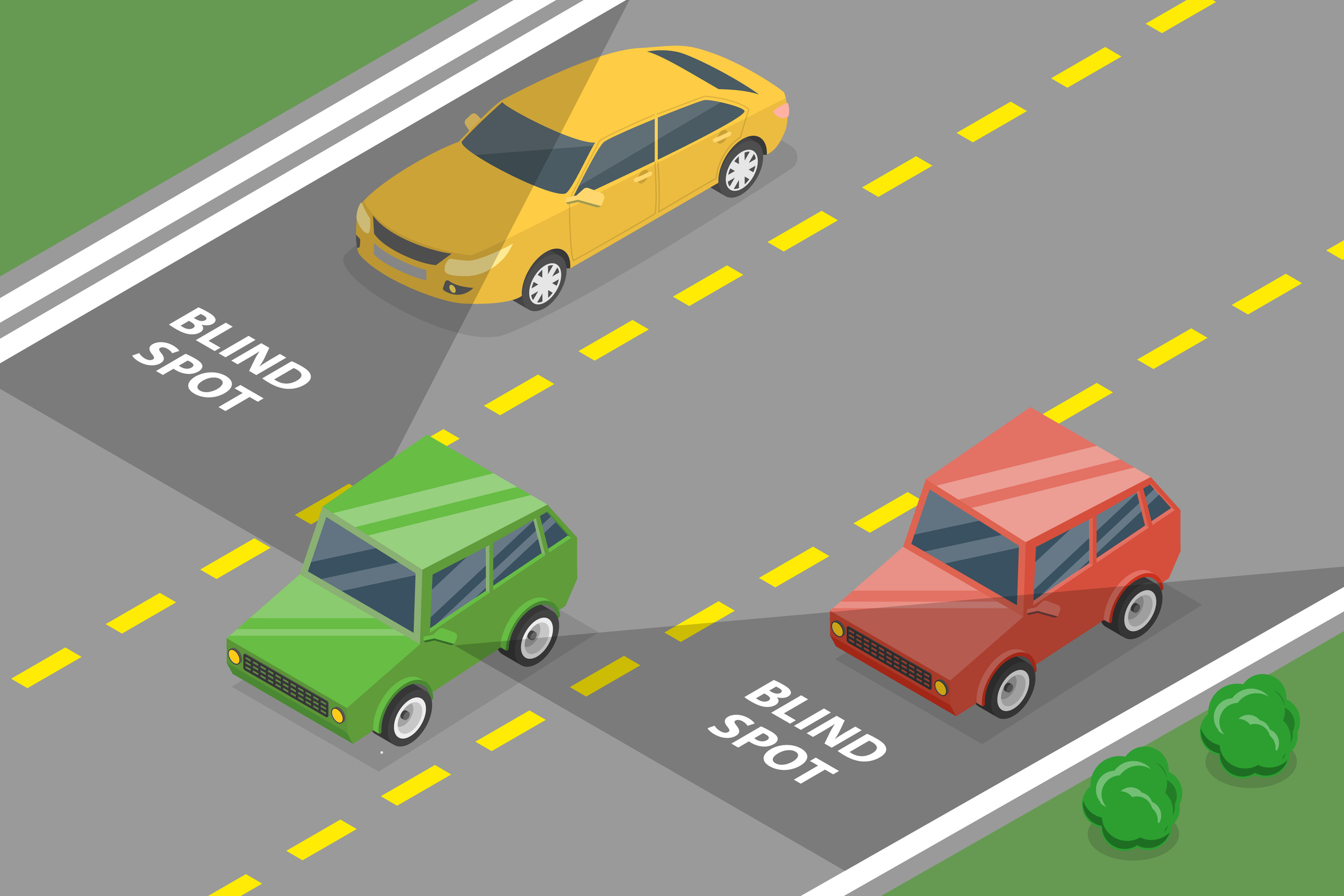
Welcome to another edition of Classic’s Automotive Terminology, Since buying a car isn’t part of our daily or weekly lives, most people aren’t familiar with all the terminology, and that’s where we come in! We help you learn the ins-and-outs of the industry lingo so you can navigate conversations with pro mechanics, automotive enthusiasts, and become an all-around more educated car owner. Today, we’re going to be talking about blind spots and the safety features in modern day cars that help us increase visibility while driving.

The Basics: What is a blind spot and blind spot detection
Blind spot
An area behind and to the side of a vehicle that is hard to see in either the side or rear view mirrors. Blind spot areas vary from vehicle to vehicle depending on make, model, size, and type.
Blind spot detection
An electronic system that warns you when there are other cars or motorcycles or objects in your blind spot, especially used when changing lanes, merging, or turning.
Where are the potential blind spots in a vehicle?
Certain elements of your vehicle’s interior construction may provide a structural component to create blind spot and skew visibility. This can include the A-Pillars, B-Pillars, C-Pillars, Roof Supports, Headrests, Infotainment screens, and overall body shape of the vehicle itself.
Larger vehicles such as Trucks and SUVs are more often subject to blind spots than smaller cars like sedans.
The mirrors offer views around and behind the vehicle but can sometimes be limited to a narrow field of vision in rear corners.
A driver’s personal seating position may also affect accessibility and visibility, as well as limiting factors such as issues with peripheral vision or even the common issue of requiring prescription glasses or contact lenses for corrective vision.

What technology or tools exist to mitigate blind spots while driving?
If you’re driving a large truck or SUV, you may be able to add an additional mirror on each side of the hood or on top of your sideview mirrors. For smaller vehicles, you can add a little blind spot mirror stick-on to your side view mirrors. Additionally, you can purchase an extended length rear view mirror. You can also remove the center middle-seat head rest from any backseat or 
Most modern automotive companies have now employed their own personalized systems of blind spot monitoring and lane keeping assistance. The onboard computer will use a series of cameras and LIDAR systems placed all around the vehicle to monitor for cars, motorcycles, pedestrians, and obstructions on the roadway. Your vehicle will then provide an audible and/or visual alert through the infotainment system or alarms to alert you to danger. In many vehicles, this system is always passively monitoring, but can become specifically activated by utilizing the turn signals.

How do we use our vehicle’s mirrors to reduce the dangers of blind spots while on the road?
We’ve all had a moment where we thought the coast was clear, only to realize while merging that a vehicle was in our blind spot! Did you know that you can avoid incidences like this by properly adjusting your mirrors? Let us break it down for you! This method was first documented in the early 1990s by George Platzer in a research paper published and presented to the Society of Automotive Engineers. Thanks to his efforts and research many automotive manufacturers have utilized his calculations to improve side mirrors, reduce blind spots, and help create a blind spot monitoring system.
To properly adjust your driver’s side mirror, sit behind the wheel and place your head on the driver’s window. Look at the mirror and adjust it so it faces outwards until you can see the adjacent lane on the road and only a small portion of the vehicle’s back end. To properly adjust the passenger-side mirrors, lean to the right so that your head is just above the vehicle center console. Look into your right-side mirror and adjust it until you can only see part of your vehicle.
To adjust your rearview mirror with the most accurate vision, ensure that you cannot see the vehicle’s ceiling, backseat, or any of your face. You should be able to see clearly centered through the back window.
Remember to adjust your mirrors each time you get into your vehicle, especially after someone else has been behind the wheel.
Even with properly adjusted mirrors, it’s always a good idea to employ the “SMOG” technique. This stands for Signal, Mirror, over the shoulder, and Go. This means you should utilize your turn signals, pause and check the mirrors, and then double check by physically turning your head and body to look over into the space you’d like to move into. You can also then verify the path is clear by utilizing your vehicle’s on-board cameras and technology for an assist, and turn into the lane or merge.

![[Facebook]](https://www.classicdirecttoyota.com/blogs/293/wp-content/plugins/bookmarkify/facebook.png)
![[LinkedIn]](https://www.classicdirecttoyota.com/blogs/293/wp-content/plugins/bookmarkify/linkedin.png)
![[Twitter]](https://www.classicdirecttoyota.com/blogs/293/wp-content/plugins/bookmarkify/twitter.png)
![[Yahoo!]](https://www.classicdirecttoyota.com/blogs/293/wp-content/plugins/bookmarkify/yahoo.png)
![[Email]](https://www.classicdirecttoyota.com/blogs/293/wp-content/plugins/bookmarkify/email.png)
Connect with us


- All-New 2027 Toyota Highlander: The Electric SUV for Illinois
- Top 5 Features of the 2026 Toyota 4Runner That Conquer Illinois Winters
- Celebrate the Holidays by Gifting a Road Trip to the Michigan Ice Fest 2026!
- Extending the Spirit of The Giving Season: Great Ways to Give Back to the Community For the Holidays (Lake County, Waukegan Area)
- Your 2025 Holiday Gift Guide for Car Lovers